Half of Our Lost Deals Were Never Lost. We Just Dropped Them.
First I connected AI to the CRMs of two companies and found thousands and tens of thousands of dollars in losses. Clients came in, left an inquiry, and were simply forgotten. I handed the reports to the owners and helped bring some of those clients back.
Then I checked my own company. All three prompts and every screenshot are below.
I run a construction company, 12 years in the market. We have been on AmoCRM that whole time. Tens of thousands of records, and still no clear picture. The CRM gets filled in about half the time. Yours probably does too. The question is what that costs us.
Three Prompts in Plain Language
I open Claude Code and write in plain language:
Connect to my CRM and show me the overall picture for 2022.
Load only 2022, do not pull everything.

AmoCRM, credentials are in the file ~/Downloads/amo_token.txt.

Do not show client names or phone numbers.
Convert all amounts to dollars at the current rate if you show any amounts.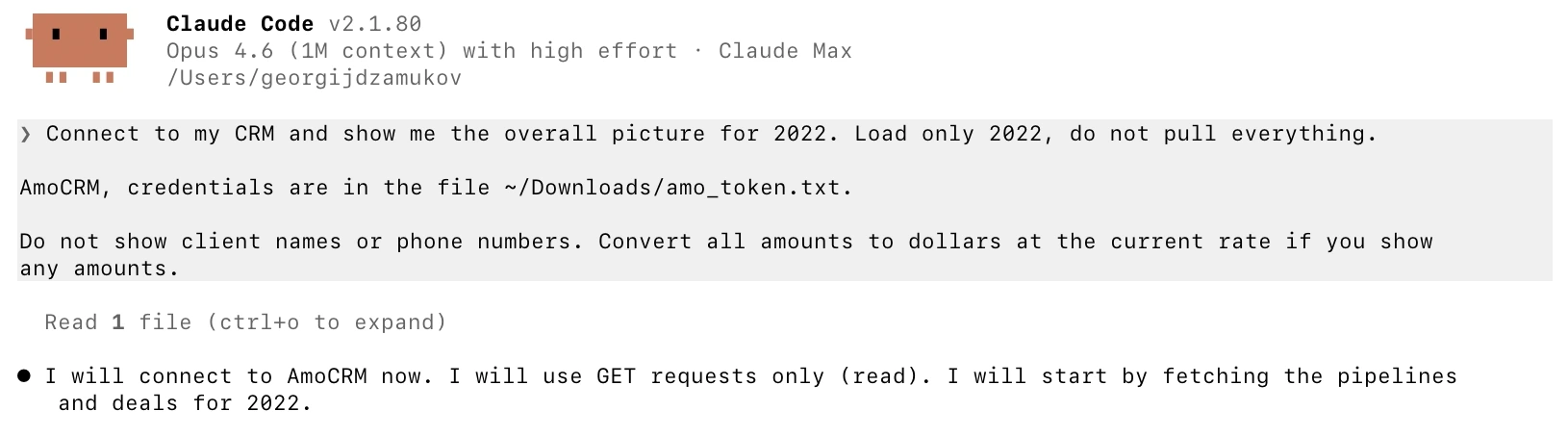
Found: 9,354 Deals, 1.3% Conversion
Claude Code pulled everything out of the CRM, structured it and returned the result in a readable format. It reports 9,354 deals created. 126 closed won. 9,099 closed lost. 129 still in progress in the logistics pipeline. Conversion 1.3%. That looks low, but everything lands in the CRM: calls, forms, spam.
Budget of all deals $1.95M. Won $686K. Lost $555K. Average deal $5,449.
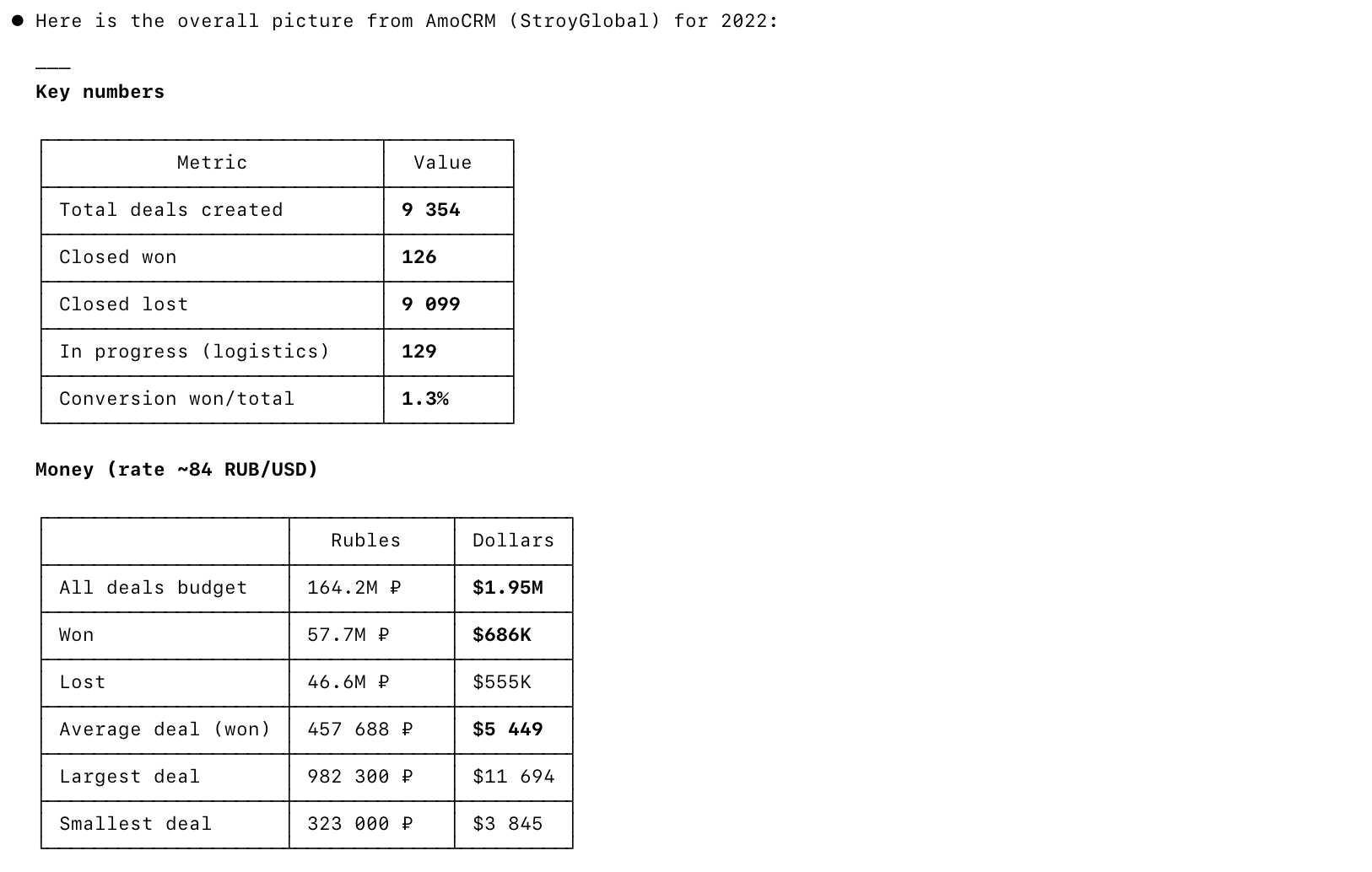
Seasonality is pronounced: leads peak from January to March, then fall in summer and toward the end of the year. The first half of the year brought $533K in signed deals, 78% of the annual total. December was empty.
Two more things from the same table. In December we got 214 inquiries and won nothing at all. And conversion in the second half of the year was 1.02% against 1.48% in the first. Leads kept coming, ad money kept going out, and the handling dropped by a third.
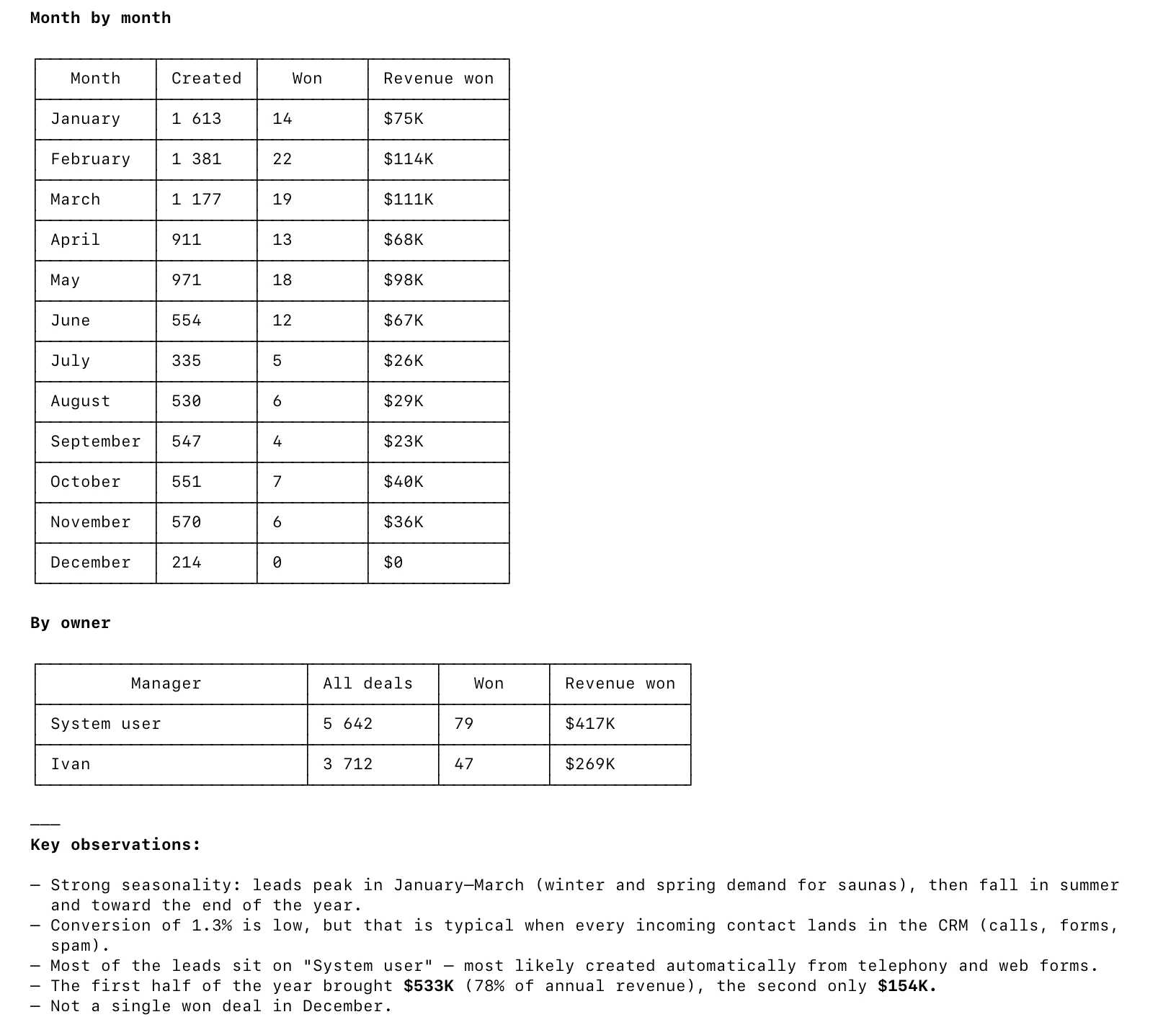
The model laid the whole year out in readable tables and drew its conclusions from that data.
I write the second prompt:
OK, that is the statistics. Now find me the clients everyone forgot about.
The ones nobody touched for more than a month. Find the biggest losses.
AI Splits the Lost Deals Into Groups
The model splits them into categories. Two of those are worth a look.
Dropped fast. 26 deals worth $135K were marked lost. The largest of them: $7,881, $6,083, $5,952 and $7,987. Average size in this group is $5,192, against $5,444 for a deal we won. These were not small enquiries.
Forgotten large deals. 23 deals worth $124K. They sat for 60 to 857 days and were then simply closed. The record holder is a deal worth ~$7,300 that sat for 857 days, 2.3 years. The client was forgotten for more than two years.
Look at how detailed the answer is:
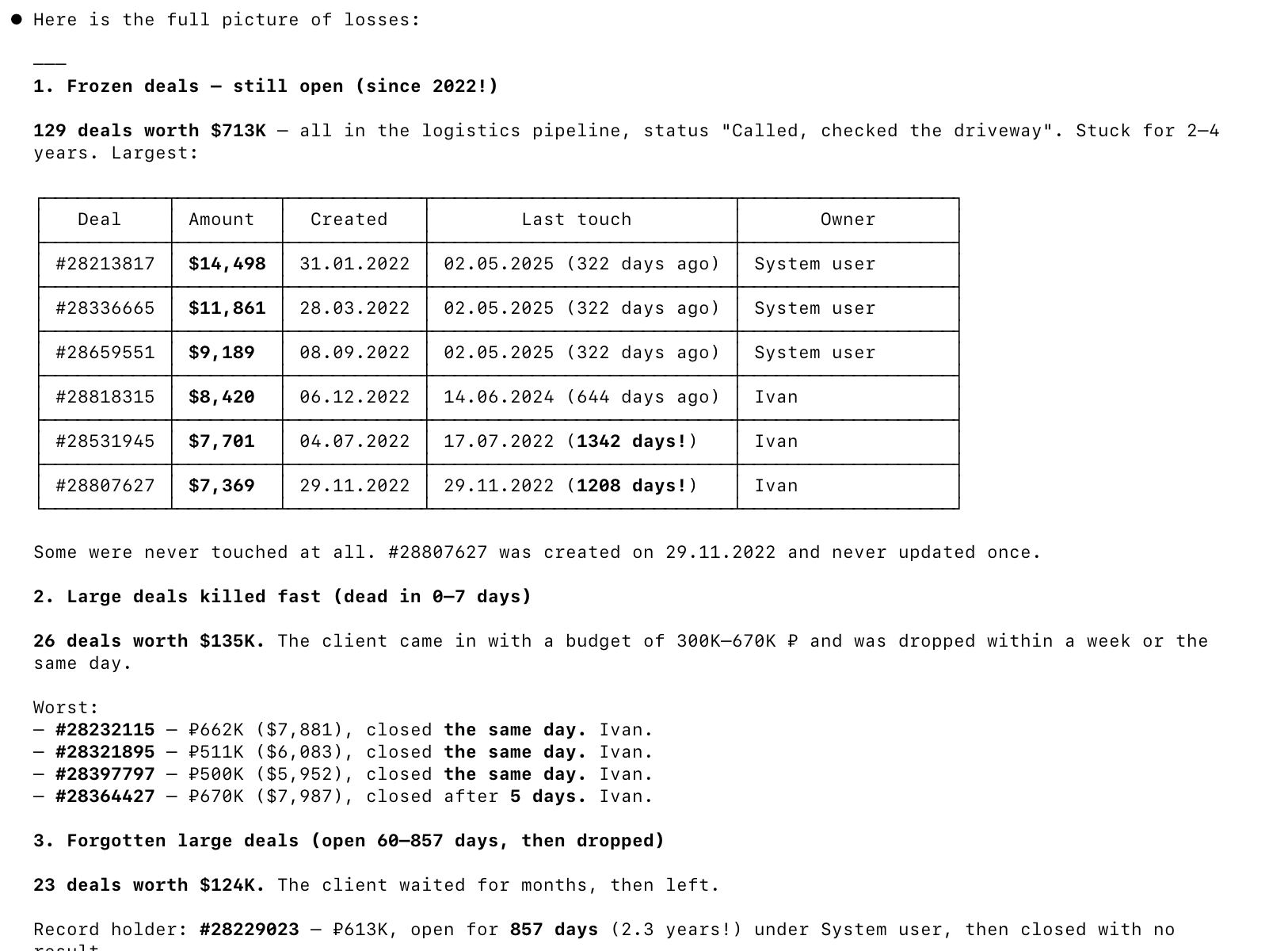
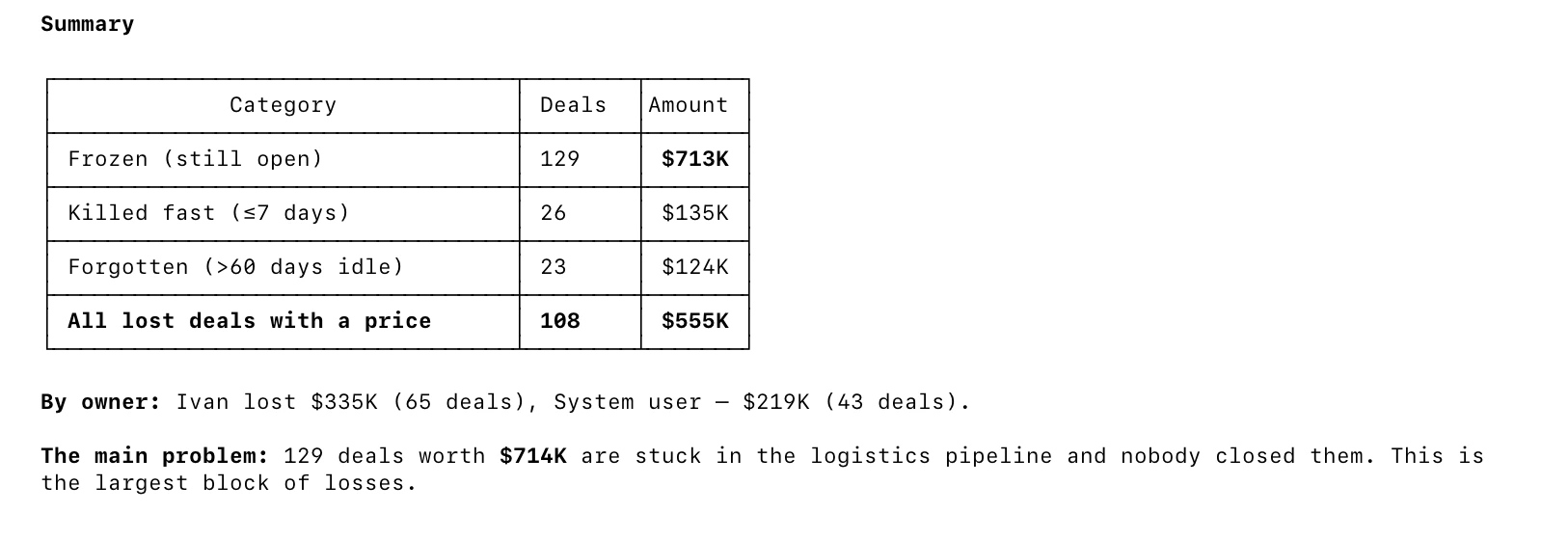
Of 108 lost deals, 49 were never lost by anyone.
They were dropped early or forgotten for months.
How Much of That Is Real
I write the third prompt:
Add up how much money we lost in total. Frozen, lost,
every deal that has a price. For 2022 only.
108 deals with a price tag were marked lost, $555K in total. Calling all of them losses would be silly: some were never going to build anything, some changed their minds, some went to competitors.
But 49 of those 108 were not lost by anyone. 26 were dropped early, 23 sat for months and were then closed. $259,000 of budget. 45% of everything we lost that year.
49 deals in one year. One year out of twelve. I have not looked at the other eleven yet.
CRM Data Is Not Enough. Calls Tell You More
In the CRM, managers drag cards from one column to another, fill in some fields and skip others. It is hard to draw an exact conclusion from that.
Calls are different. That is a real conversation. AI finds the exact lines where the client wants to order and the manager lets them go. In an earlier article I gave AI a thousand real calls from these same managers. It found problems that CRM data will never show.
But even a one-off call analysis does not solve the problem. Managers do not fill in the CRM. No set of rules works. I tried for 12 years. I had a head of sales. But he cannot listen to dozens of calls a day and check every card. You need a supervisor who listens, reads the chats, checks the CRM. And even they will not manage it fully, and will burn out fast.
But now there is AI. It can listen to every call in real time, read every conversation, review every card. For each lead you can see what is happening right now. A manager said the wrong thing, gave the client inaccurate information, or something truly absurd is going on: the owner finds out instantly. No head of sales can do that.
In practice, you and I can now put the sales department under total control: every conversation and every word every manager says.
Want to know how many forgotten deals are sitting in your CRM?
Write to me and I will connect AI and show you.
Message me on LinkedIn